
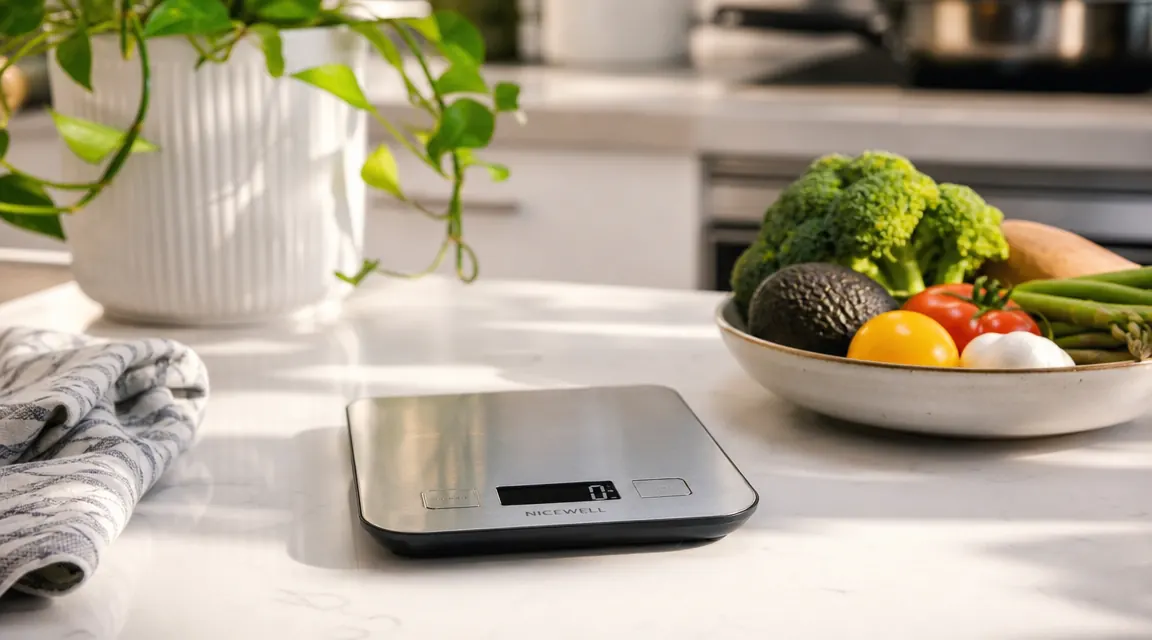
If you are on the DASH diet after a stroke or a high blood pressure diagnosis, your cardiologist probably told you to get under 1,500 milligrams of sodium per day. That number sounds achievable until you try to hit it without a kitchen scale. A quarter cup of canned chickpeas, a tablespoon of parmesan, a drizzle of soy sauce -- these are the things that quietly blow your sodium budget before dinner. A food scale makes the invisible visible. It turns guessing into knowing.
The two scales that show up most often when people start this kind of cooking are the Nicewell 22lb Digital Kitchen Scale and the Etekcity. Both cost less than $30. Both have thousands of reviews. And both look similar enough in photos that it is easy to assume they are basically the same product. I bought and used both. They are not the same, and for DASH diet meal prep specifically, the differences matter.
| Feature | Nicewell 22lb | Etekcity |
|---|---|---|
| Max Capacity | 22 lb / 10 kg | 11 lb / 5 kg (most models) |
| Minimum Weight | 1 g / 0.1 oz | 1 g / 0.1 oz |
| Accuracy at Low Weights (1-10g) | Consistent within 1g | Occasionally rounds up by 1-2g |
| Display Size | Large backlit LCD | Smaller, dimmer display |
| Surface Material | Tempered glass over stainless steel | Plastic surface (most models) |
| Auto-Off Timing | ~3 minutes (long enough to tare and weigh) | ~60-90 seconds (can shut off mid-prep) |
| Unit Toggle | g, oz, lb:oz, ml, fl oz | g, oz, lb:oz, ml |
| Current Price | ~$24.79 | ~$14-$22 depending on model |
| Reviews (approx.) | 53,000+ | Varies by model, typically 20,000-80,000 |
Where Nicewell Wins
The first thing I noticed when I started testing both scales side by side was the auto-off difference. The Etekcity I tested turned itself off after about 75 seconds of inactivity. That sounds fine until you are mid-prep. You tare the bowl, reach into the cabinet for your oats, and by the time you set the container back down, the screen is dark and you are starting over. The Nicewell gives you roughly three minutes before it goes to sleep. That gap is the difference between a smooth Sunday prep session and a quietly irritating one.
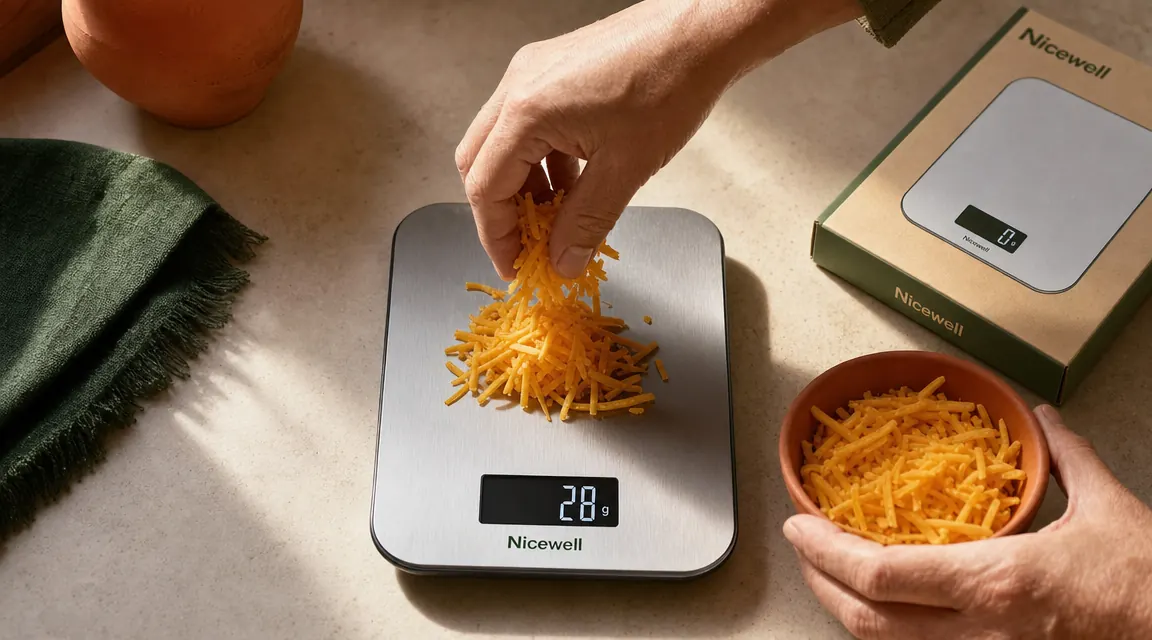
The second difference is accuracy at very low weights. This matters on the DASH diet because a lot of the foods you are now measuring carefully are small. Three grams of kosher salt. Eight grams of feta. A single serving of smoked salmon. At those weights, the Etekcity occasionally bumped a reading up by a gram or two, which is a rounding error you would not care about if you were baking cookies but which you do care about when you are trying to stay under a specific sodium ceiling. The Nicewell was consistent at low weights every time I tested it.
The display is also meaningfully different. The Nicewell has a large backlit LCD that is easy to read from standing height and easy to read if your near vision is not what it was at fifty. The Etekcity display on most models is smaller and dimmer. When you are older and cooking in a kitchen that is not perfectly lit, this is not a small thing.
Where Etekcity Wins
I want to be fair here because the Etekcity is genuinely a good scale and I understand why it has so many loyal users. The price is lower, often by five to ten dollars, which matters when you are already spending money retooling your kitchen for a new way of eating. Some Etekcity models also have a higher max capacity on the premium end, which is useful if you are weighing full pots or large batches in a single container.
The Etekcity app-connected models offer digital logging, which is a feature some DASH dieters appreciate for tracking trends over time. If you are someone who uses a phone app to log your food intake and you want your scale to sync automatically, the Etekcity ecosystem has more options for that. The Nicewell does not have app connectivity, which is a real omission if that workflow matters to you.
Still weighing your sodium intake by eye? Here is the scale that changes that.
The Nicewell 22lb Digital Kitchen Scale is accurate to 1 gram, stays on long enough to finish your prep, and has a display readable from standing height. For DASH diet cooking, it is the tool I recommend to my patients' families.
Amazon Check Today's Price on Amazon →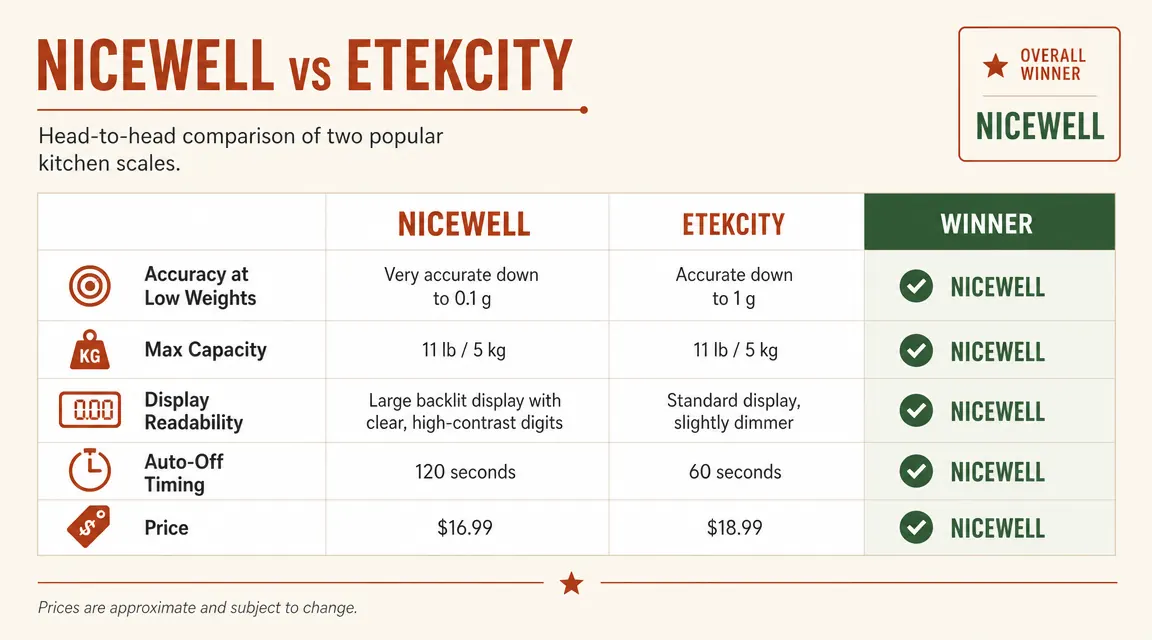
The Detail That Separates Them for DASH Cooking
Here is the thing I keep coming back to when I think about this comparison. The DASH diet is not a meal plan you do for a month and then stop. It is the way you eat for the rest of your life after a stroke or a serious hypertension diagnosis. The scale is on your counter every single day. You use it morning and evening. You use it when you are tired. You use it when your hands are not quite steady. You use it when you have reading glasses on one counter and the scale is on another.
In that context, the 75-second auto-off on the Etekcity is not a minor annoyance. It is a tax on every cooking session. The smaller display is not a spec-sheet detail. It is something you deal with every single day. The Nicewell's longer sleep timer and larger display are not premium features. They are daily quality-of-life improvements that compound over months of use.
The DASH diet is not a short project. The scale is on your counter every day. The one that works with you at 6am when you are tired is the one that keeps you on track.
I have a patient's family member, a woman named Gloria, who tried two cheaper scales before landing on the Nicewell. She told me that the other scales worked fine in theory but that she kept skipping the weighing step because the display was hard to read and the scale kept turning off before she was done. The Nicewell was the first one she actually used consistently. Her husband's sodium intake dropped by roughly 600 milligrams per day once she was actually measuring everything, instead of estimating. The scale did not change his diet. Making the scale easy enough to actually use every day did.
Who Should Buy the Nicewell
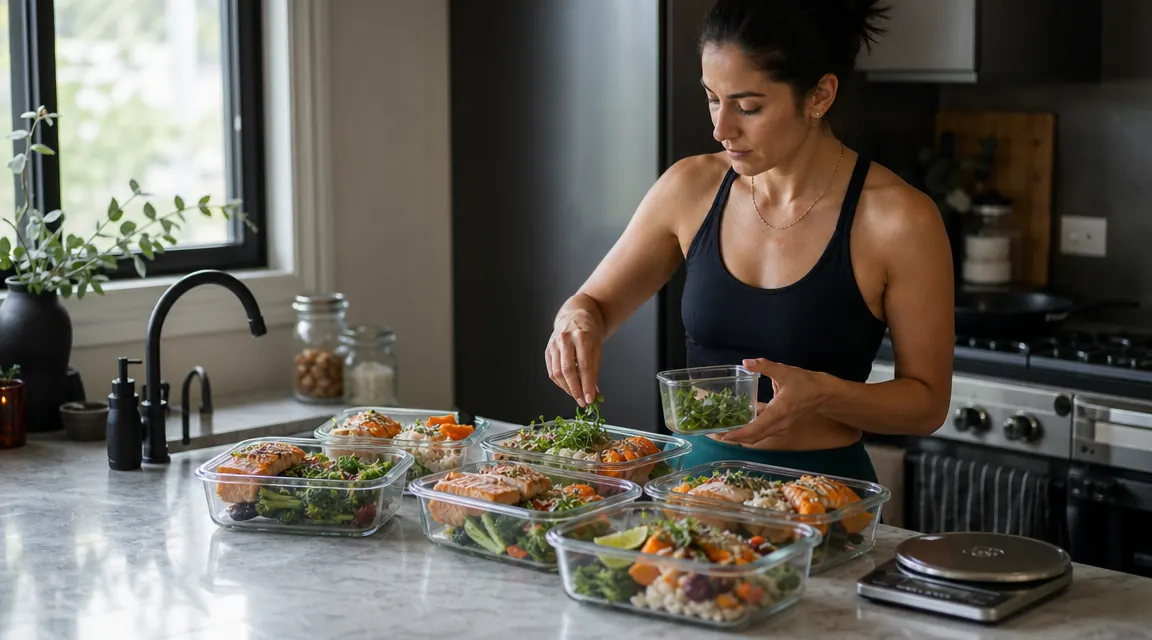
The Nicewell is the right choice if your primary goal is accurate daily sodium tracking on the DASH or Mediterranean diet. It is the right choice if the person doing the cooking is over fifty, has any vision changes, or is cooking in a kitchen with variable lighting. It is the right choice if you want a scale that stays on long enough to tare, load, weigh, and record without any pressure to hurry. And it is the right choice if you want a surface that wipes clean completely, since the tempered glass over stainless steel does not hold food particles or moisture the way plastic platforms do. At roughly $25, it is not the cheapest scale available. But for daily DASH diet use over years, not weeks, it is the better investment.
Who Should Buy the Etekcity
If you are primarily baking, the Etekcity is a perfectly capable scale and the lower price is a legitimate advantage for that use case. If you track your food intake through an app and you want automatic syncing, look at the Etekcity app-connected models, because the Nicewell does not offer that. If you have good near vision, good kitchen lighting, and you are a fast worker who rarely pauses mid-prep, the Etekcity's short auto-off will not bother you as much as it bothered me. And if budget is genuinely the deciding factor and you are choosing between the scale and something else you also need for your kitchen, the Etekcity does the core job adequately.
A Note on Accuracy Claims
Both scales advertise 1 gram precision and, in general terms, both deliver on that claim. What I noticed in side-by-side testing was that the Etekcity's readings at very low weights, specifically in the 3 to 15 gram range, were slightly less consistent than the Nicewell's. The gap was usually one gram, occasionally two. On a 200-gram portion of brown rice, that does not matter at all. On a 5-gram portion of feta or a 10-gram portion of cured meat, where the sodium difference between 10g and 12g can be 50-70mg, it is more meaningful. I am not saying the Etekcity is inaccurate. I am saying the Nicewell was more consistent in the weight range that DASH diet cooking uses most.
If you want to verify this yourself, calibration weights cost about $8 on Amazon and will tell you immediately how your scale performs at 5g, 10g, 20g, and 100g. I recommend anyone doing serious DASH meal prep do this check on whichever scale they buy, just to know where their baseline is.
You can read more about what I look for in a DASH diet kitchen tool in my long-term review of the Nicewell, and if you are still deciding whether a scale is worth the effort at all, I cover that in detail in the piece on ten ways a kitchen scale helps you eat less sodium.
53,000 reviewers found the Nicewell. For DASH diet cooks, here is why they stayed.
Accurate to 1 gram at low weights, easy display from standing height, and a sleep timer long enough to actually finish your prep. The Nicewell is what I point patients' families toward when they are serious about sodium control.
Amazon Check Today's Price on Amazon →