
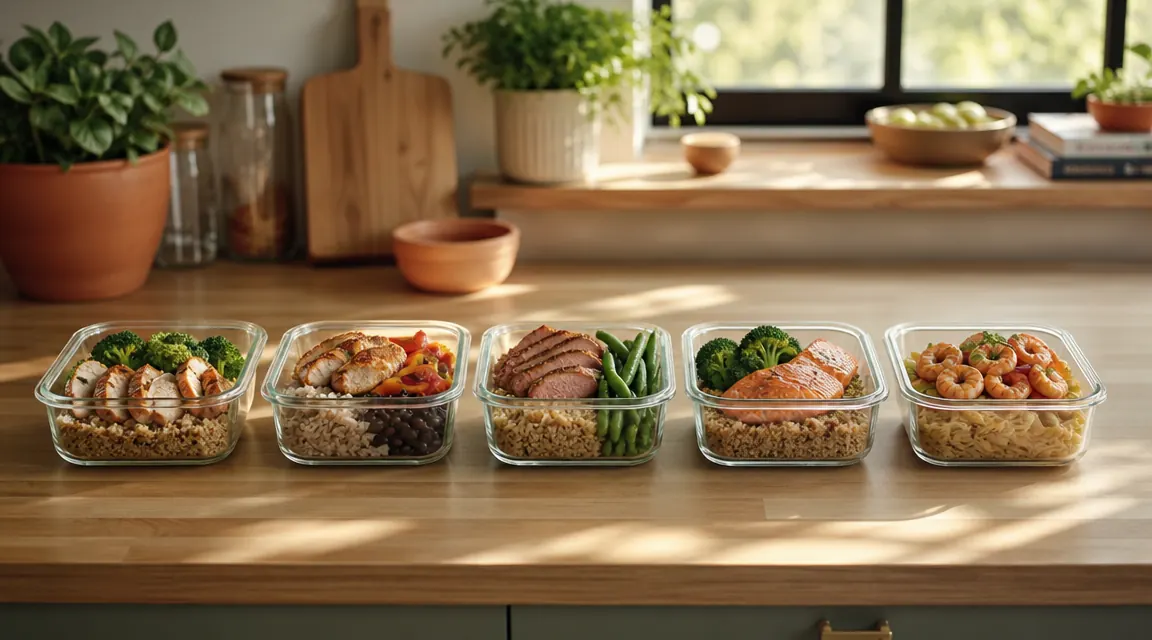
Every Monday morning on the stroke unit, I watch the same pattern repeat. Someone comes back in. We look at the chart. Their sodium intake the week before was 3,400mg a day, maybe 4,000mg. And there is always a moment where the family member in the chair says, "But we were trying. We really were trying." I believe them. Trying without a system is still just trying. After twenty-two years coordinating stroke care and cooking for my own household, I have come to believe one thing firmly: the only way to reliably hit a 1,500mg-per-day sodium target is to build the math into your Sunday, before the week starts and before hunger is in charge.
The single tool that makes Sunday prep math possible is a digital kitchen scale. Not a measuring cup. Not a tablespoon. A scale, because the nutrition facts on every food label are written in grams, not scoops. A tablespoon of tahini dressing can be anywhere from 11 to 19 grams depending on how you pour it. That is a 50-percent swing in sodium before you have taken your first bite. Once you start weighing instead of eyeballing, the sodium math stops being a guess and becomes something you can trust. This guide walks you through exactly how I build five weekday lunches in about ninety minutes on a Sunday afternoon, each one landing under 600mg of sodium.
Your sodium budget slips most when you estimate portions. A scale fixes that.
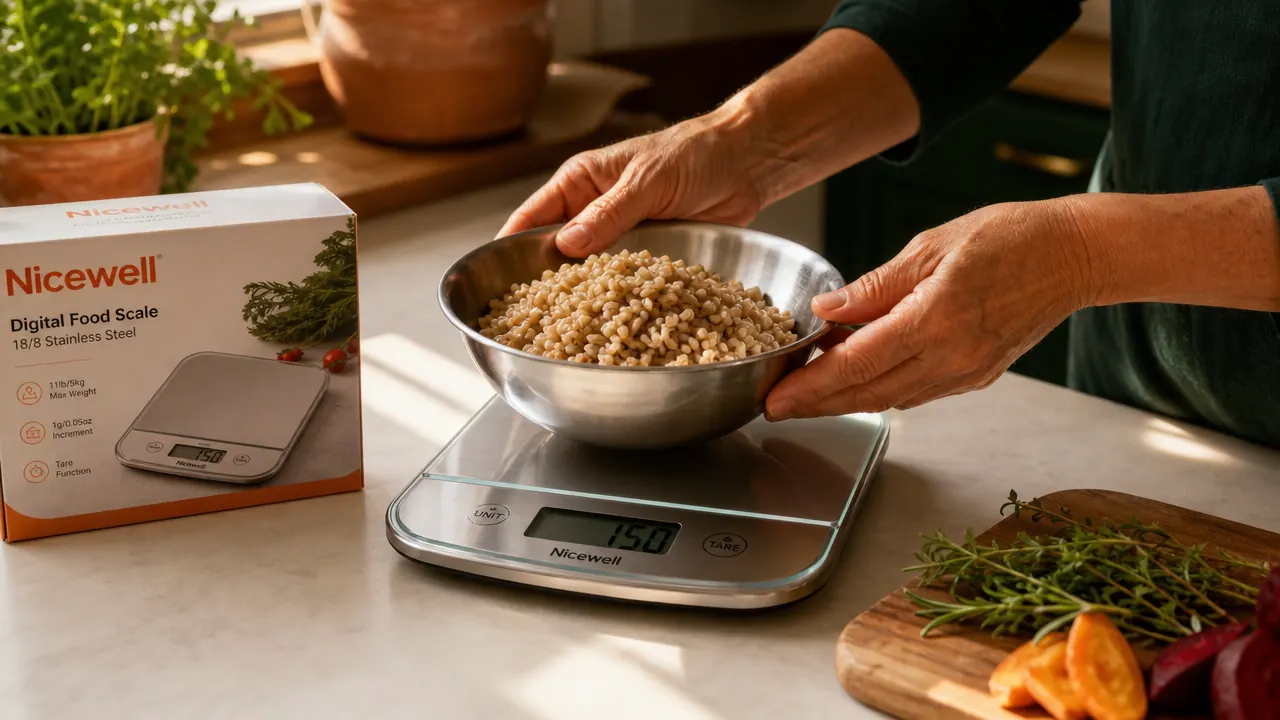
The Nicewell Food Scale reads in 1-gram increments, handles up to 22 lbs, and has a tare function that resets after every ingredient. It is the scale I recommend to every patient family building their first low-sodium kitchen routine.
Amazon Check Today's Price on Amazon →Step 1: Gather Your Ingredients and Tools Before You Start
Set up your workstation the night before or first thing Sunday morning. You need five airtight lunch containers (I use wide-mouth quart mason jars or BPA-free glass containers), a digital scale, one large pot for grains, one sheet pan for roasting, and a mixing bowl. For a week's worth of lunches I shop for a grain base, a lean protein, two to three vegetables, and one dressing. My go-to shopping list: one cup dry farro (about 180 grams), one pound boneless chicken breast or two cans of no-salt-added chickpeas, one bunch of kale, two bell peppers, one English cucumber, one lemon, and one bottle of a bottled dressing that clocks under 150mg sodium per 30-gram serving.
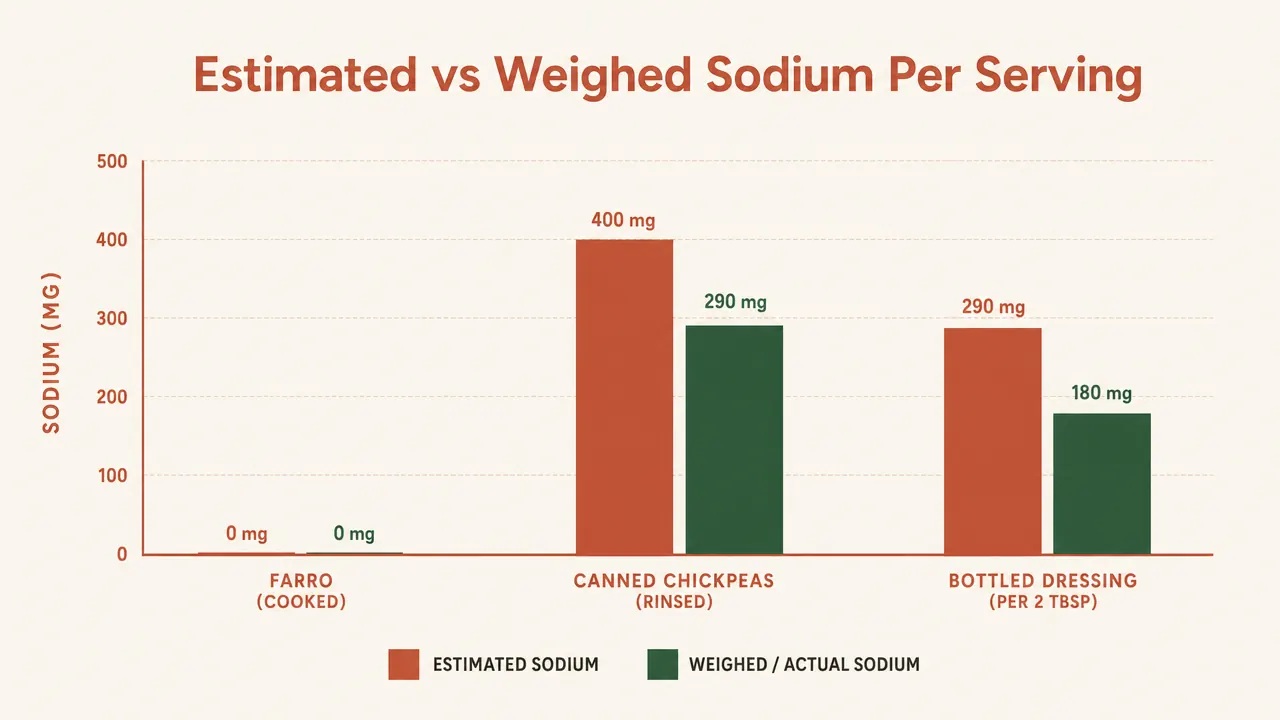
Ingredient sourcing matters almost as much as weighing. Rinse every canned legume under cold water for thirty seconds. A study published in the Journal of the Academy of Nutrition and Dietetics found that rinsing canned beans cuts their sodium by 40 percent. On a standard can of chickpeas with 350mg per half-cup serving, that rinse saves you roughly 140mg per portion. I weigh the chickpeas after rinsing because the water changes the weight slightly, and I want my numbers to reflect what I am actually eating.
Step 2: Cook and Weigh Your Grain Base
Cook farro or brown rice in plain water with no added salt. One cup of dry farro yields about 500 grams of cooked grain. You are dividing that into five portions of exactly 100 grams each. Put your container on the scale, press tare to zero it out, and spoon grain in until the display reads 100. Then move to the next container. This sounds slow until you do it twice. By the third Sunday it takes three minutes.
Why 100 grams and not a half-cup? Because a half-cup of cooked farro can be anywhere from 85 to 130 grams depending on how compacted it is. The sodium in farro itself is essentially zero, which means the grain is not your risk here. But getting the weight right now means your overall calorie budget is consistent, which keeps the portion sizes honest across all five containers and leaves more room in your sodium budget for the dressing.
Once you start weighing instead of eyeballing, the sodium math stops being a guess and becomes something you can trust every single day of the week.
Step 3: Portion Your Lean Protein
For chicken breast, cook it plain in the oven at 375 degrees until it reaches 165 degrees internal temperature. No marinade with soy sauce, no seasoning blends, no store-bought rub. Season with garlic powder, smoked paprika, black pepper, and a squeeze of lemon. One pound of raw chicken breast yields roughly 340 to 360 grams of cooked meat. You want 70 grams per lunch container, which gives you five servings from roughly 350 grams. Set each container back on the scale after adding the grain, press tare, then add chicken until you hit 70.
If you are going the chickpea route, drain and rinse one 15-ounce can, then weigh out 85 grams per container. That gives you about 7 grams of protein, 4 grams of fiber, and, after rinsing, roughly 160mg of sodium per portion. Compare that to the unreduced 270mg you would get without rinsing, and you have saved yourself 110mg per lunch before you have even touched the dressing. On the unit we call those hidden wins, small correct choices that stack up faster than people think.
Step 4: Add Vegetables and Weigh Everything Together
This is where the scale pays for itself in a different way. You do not need to weigh fresh vegetables as carefully as you weigh grains, protein, or dressing, because most raw vegetables contribute almost nothing to sodium. Kale, bell pepper, cucumber, cherry tomatoes, shredded cabbage, all effectively zero. But I do weigh the total container after adding vegetables so I can track total meal weight across the week. That consistency matters when you are adjusting a recipe next month and want a real baseline to work from.
For each container: add a handful of torn kale, about 40 grams, a quarter of a sliced bell pepper, and a few slices of cucumber. These add fiber, potassium, and magnesium, all of which have real evidence supporting their role in blood pressure management. I mention the mechanism because I want you to feel good about loading up the vegetable portion, not anxious. There is no sodium ceiling to worry about with cucumber. Fill that side of the container.
Step 5: Portion Dressing Into Separate Small Containers
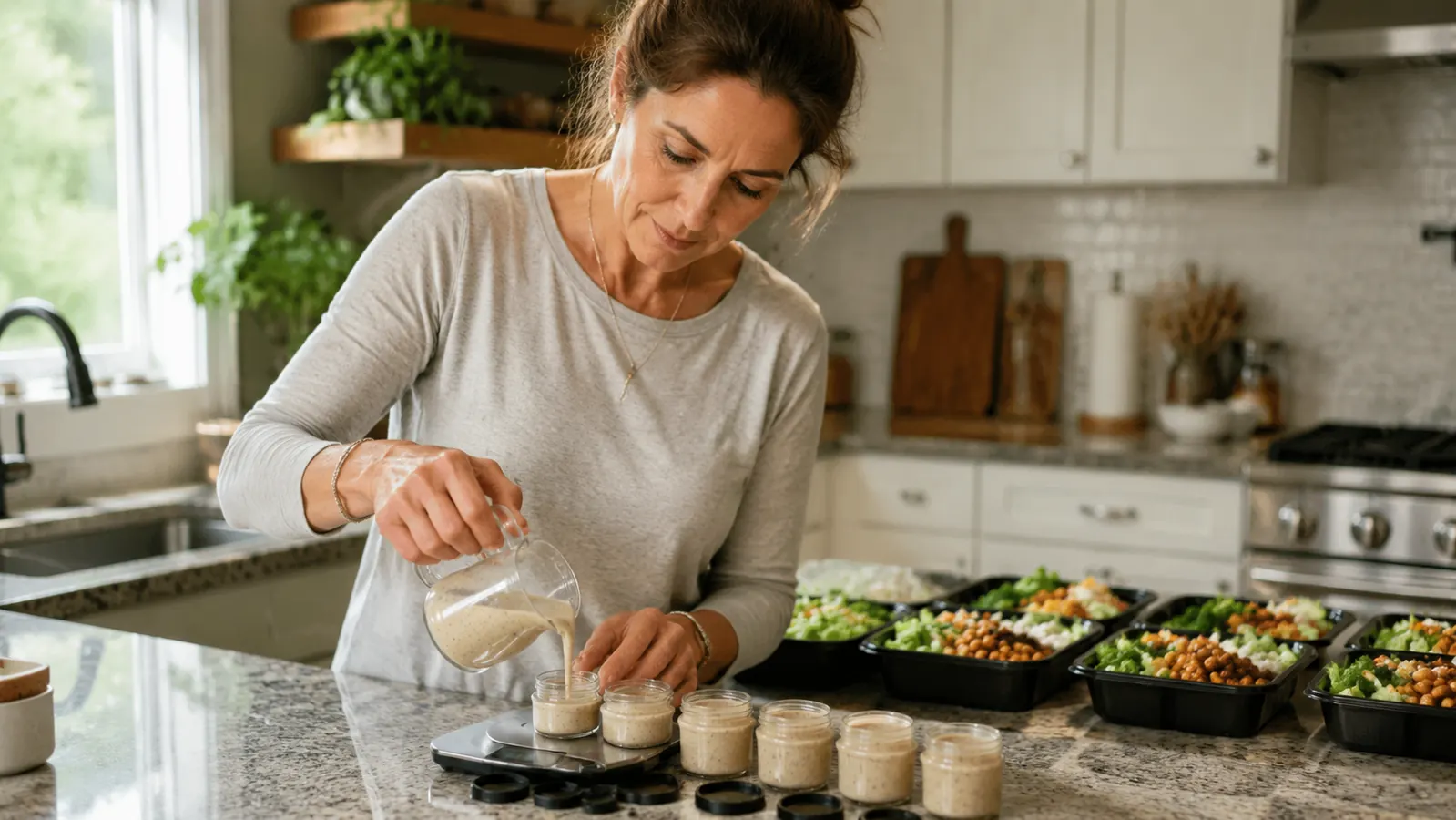
This is the step most people skip, and it is exactly where their sodium budget explodes. Dressing is not the enemy. An unmeasured pour of dressing is the enemy. I keep a set of small screw-top containers, about two ounces each, and I portion dressing into them separately so I add it at the table, not in the prep container. This keeps the greens crisp through Friday and lets me weigh the dressing precisely.
Weigh out 20 grams of your chosen dressing per portion. Most bottled dressings list a 30-gram serving at around 200 to 280mg sodium. At 20 grams you are at roughly 130 to 185mg per lunch. That is your dressing budget for the day and it is tight but manageable. If you want more flavor, squeeze a little fresh lemon juice directly onto the greens before adding the dressing. Lemon adds brightness and zero sodium. I do this myself every single week.
What Else Helps When You Are Building This Habit
A scale is the mechanical foundation, but a few other practices make the whole system more durable. Keep a sticky note on your refrigerator door with the sodium total for each container. On weeks when I do this, I feel less anxious opening the fridge at noon because I already know the number. When I skip the note, I start second-guessing myself by Wednesday, and second-guessing leads to abandoning the system and reaching for a frozen meal with 980mg of sodium.
Batch cook twice a month rather than every week. The farro freezes beautifully. I cook a double batch, about two cups dry, every other Sunday, and freeze half in 100-gram portions in small zip bags. The night before a prep session I pull the grain bags from the freezer. This cuts the total Sunday prep time to under an hour on alternating weeks, which means the habit is more sustainable through busy seasons. On my stroke unit we talk a lot about sustainability because a habit that falls apart during a stressful week is not actually a habit.
Finally, if your sodium target is 1,500mg daily, your five lunches at 550mg each leave you 950mg for breakfast and dinner combined. That sounds tight. It is. But a breakfast of plain oats with banana and unsalted almond butter runs about 60mg. You have a lot of room for a satisfying dinner. The scale works best when it is part of a total daily picture, not an isolated lunch habit. I track the day in a small notebook, nothing complicated, just three lines: breakfast sodium, lunch sodium, dinner goal.
If you want a deeper look at how I use the Nicewell scale specifically for DASH diet tracking over eight months, I wrote up everything I observed in my long-term Nicewell Food Scale review. And if you are building out a full low-sodium cooking routine beyond lunches, my guide on how to cook low-sodium soups and stews with a Dutch oven covers the same kind of step-by-step approach for dinner.
The scale that makes the sodium math real, instead of a daily guess.
The Nicewell Food Scale reads in 1-gram increments, has a responsive tare button, and the stainless steel platform wipes clean in seconds. At 53,000 Amazon reviews and a 4.7-star rating, it is the most proven budget scale for this kind of daily prep work. Check current pricing below.
Amazon Check Today's Price on Amazon →